Patients often ask me which longevity numbers matter. We measure so many things now. Blood pressure. Cholesterol. Glucose. Body composition. Sleep scores. Heart rate variability. It can start to feel like health is just a dashboard, but not all metrics carry the same weight.
So What Is VO₂ Max, Really?
When I think about what truly predicts resilience as we age, one number consistently rises to the top: VO₂ max. It is usually labeled as a “fitness” measurement, which I think undersells it. Clinically, it tells us something much more important. It reflects how well your body uses oxygen when it is pushed. And that single concept captures how your heart, lungs, blood vessels, and muscles function under stress. That coordination matters more than most people realize.
VO₂ max stands for maximal oxygen uptake. In practical terms, it is the highest amount of oxygen your body can use during intense exercise. When you walk up stairs, lift weights, or push yourself on a bike, your muscles demand oxygen. Your heart has to deliver it. Your lungs have to exchange it. Your blood has to carry it. Your cells have to convert it into energy and your muscles have to use that energy to move your body.
VO₂ max reflects how that entire process works. This is why I think of it more as a systems-level measurement than a fitness score. It shows us how strong your physiologic engine is.
Why It Is So Closely Tied to Longevity
Over the past two decades, large population studies have consistently shown that cardiorespiratory fitness strongly predicts survival. In some analyses, it rivals or exceeds traditional risk factors in its predictive power. That does not mean blood pressure or cholesterol stop mattering. They do.
What VO₂ max seems to capture is overall resilience. When VO₂ max is higher, we tend to see better insulin sensitivity, healthier vascular function, lower inflammatory burden, and stronger mitochondrial performance.
In other words, the body adapts well. And adaptation is the essence of aging well. The people who maintain capacity as they move through midlife and beyond tend to preserve independence, mobility, cognitive clarity, and metabolic stability. VO₂ max is one way we quantify that capacity.
What Is “Normal”?
VO₂ max naturally declines with age. Without training, it can drop roughly ten percent per decade after the mid-twenties, and even faster after fifty. Men and women also differ physiologically. On average, men have higher VO₂ max values due to differences in hemoglobin levels and body composition. That reflects biology, not effort.
Reference ranges help us understand context, but they are not verdicts. I use them as starting points with patients. What matters most is direction. Is it improving with time? Is it declining faster than expected? That tells me more than a single number.
Here are general reference ranges:
Women
Ages 30–39
Low: under 31
Average: 31–38
Above average: 39–45
Excellent: over 45
Ages 40–49
Low: under 28
Average: 28–35
Above average: 36–41
Excellent: over 41
Men
Ages 30–39
Low: under 35
Average: 35–43
Above average: 44–52
Excellent: over 52
Ages 40–49
Low: under 31
Average: 31–39
Above average: 40–48
Excellent: over 48
It Is Not Just About Exercise
Exercise is the most obvious lever for improving VO₂ max, but it is not the only one.
Sleep quality changes how well your body adapts to training. Chronic stress influences recovery. Thyroid function, estrogen, testosterone, and growth hormone all affect muscle mass and oxygen delivery. Iron deficiency alone can blunt improvement.
So when I see a VO₂ max that surprises me, I do not assume someone “isn’t fit enough.” I step back and ask what might be influencing the system and how do we look beneat the surface. That is often where the more interesting conversation begins.
How We Measure It
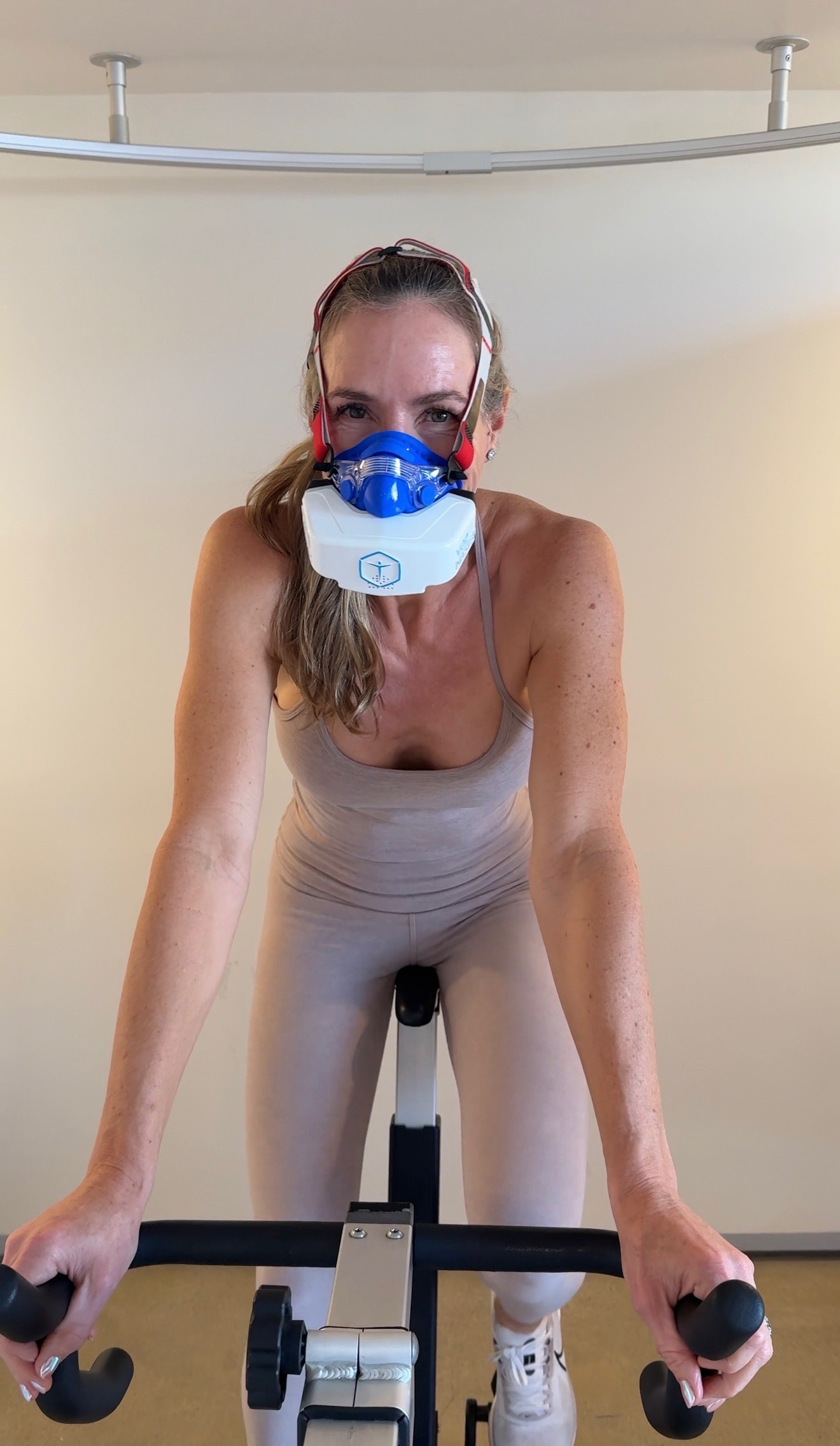
The most accurate way to measure VO₂ max is through a graded exercise test in a laboratory. You walk or cycle while wearing a mask that measures oxygen intake and carbon dioxide output. Heart rate is monitored as intensity increases until maximal effort is reached. It is precise and informative.
At the same time, wearable devices have improved significantly. Garmin, Oura, WHOOP, and some Apple devices provide estimates based on heart rate and movement patterns. They are not perfect, but they are often directionally helpful.
I recommend obtaining one formal baseline measurement. After that, tracking trends through a wearable can be very useful. In many cases, watching the trajectory matters more than chasing a single ideal number.
When Testing Makes Sense
VO₂ max testing can be helpful if someone wants a clearer picture of cardiovascular fitness. It is also valuable when building a structured training program, or when we are taking a proactive approach in midlife and beyond.
It may not be the first step for someone who is just beginning to move again after years of inactivity. In those cases, we often focus on building consistency first. Measurement works best when it supports existing action.
How It Improves
Improvement does not happen overnight.
Steady aerobic training, often called Zone 2 work, builds mitochondrial density and stroke volume over time. Higher intensity intervals can further challenge oxygen utilization. Strength training preserves muscle mass, which becomes increasingly important as we age.
None of it works well without recovery and I believe that’s important to note from the beignning. Sleep, protein intake, and balanced nutrition are part of the process and not optional.
How It Fits Into the Bigger Picture
In my practice, VO₂ max is one piece of a broader conversation about resilience. If the number is lower than expected, we explore why. If it improves, we look at what supported that improvement. It becomes a reflection of how the system as a whole is functioning.If you are curious about where you stand with VO₂ max, or if you would like to incorporate more intentional cardiovascular training into your long-term care, let’s talk. We can decide together what to measure, when to measure it, and how to use that information thoughtfully.
